Magnetic Plates: stability, precision and repeatability in industrial processes.
In industrial machining, manufacturing and assembly processes, the correct fixation of parts is a determining factor for the final quality of the product. Any improper movement during operation can generate dimensional deviations, finishing defects and rework. In this scenario, magnetic plates stand out as fundamental solutions to guarantee stability, precision and repeatability in industrial processes.
In this article, you will understand what magnetic plates are, how they work, what their main benefits are and why they are widely used in industrial environments that require a high level of control and standardization.
What are magnetic plates?
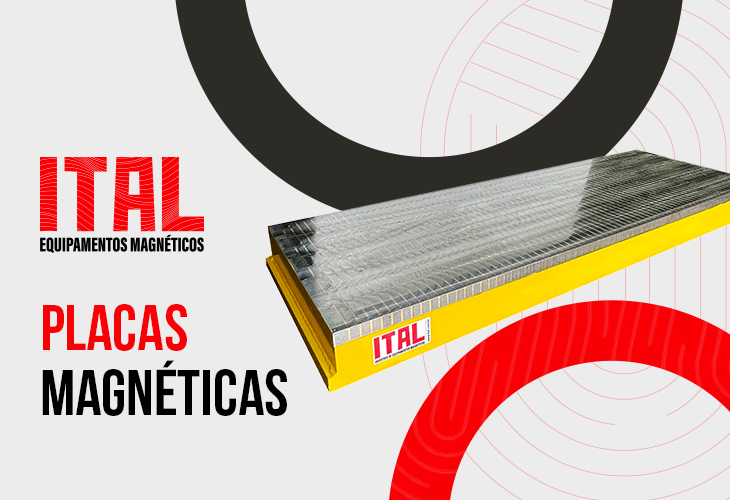
Magnetic plates are clamping devices used to keep metal parts firmly positioned during industrial operations, such as machining, grinding and assembly. They use magnetic force to ensure continuous adhesion of the part to the base, eliminating the need for mechanical clamps or complex fastening systems.
This type of solution allows for quick, safe and uniform fixing, providing greater operational efficiency and better use of productive time.
How magnetic plate technology works.
The operation of magnetic plates is based on the generation of a magnetic field distributed homogeneously over its surface. This field creates a constant force of attraction between the plate and the metal part, keeping it stable throughout the operation.
By activating or deactivating the magnetic system, the operator can quickly fix or release the part, without compromising the safety or precision of the process. This control facilitates quick changes and improves the production flow.
Stability and control during industrial processes.
The main advantage of magnetic plates is the absolute stability they offer. With the part firmly fixed, there is a significant reduction in vibrations, displacements and micro movements that could compromise the final result.
With greater stability:
- dimensional accuracy is maintained,
- the surface finish is more uniform,
- the risk of errors and failures is reduced,
- process reliability increases.
This feature is essential in industrial operations that work with strict tolerances and high quality standards.
Accuracy and repeatability of results.
In industrial environments, repeatability is as important as precision. Magnetic plates allow the same clamping pattern to be repeated in different production cycles, ensuring consistency in results.
This repeatability contributes to:
- standardization of production.
- reduction of variations between parts.
- lower rework rate.
- greater quality control.
As a result, magnetic plates become strategic allies for continuous and highly demanding industrial processes.
Productivity gains in the industrial environment.
In addition to precision, magnetic plates directly impact productivity. The ease of fixing and releasing parts reduces machine setup time, allowing operations to start more quickly.
Among the main gains are:
- reduced preparation time.
- greater agility in changing parts.
- better use of the machine.
- increased operational efficiency.
These factors contribute to leaner and more competitive processes.
Main applications of magnetic plates.
Magnetic plates are widely used in various industrial segments, such as:
- machining and grinding.
- milling and mechanical manufacturing.
- metal and steel industries.
- industrial maintenance.
- production and assembly lines.
Its versatility allows application in different types of machines and processes, always with a focus on stability and precision.
When choosing magnetic plates.
The use of magnetic plates is recommended whenever the operation requires:
- secure fixation of metal parts.
- high dimensional accuracy.
- repeatability in processes.
- reduction in setup time.
- greater industrial productivity.
Compared to conventional fastening systems, magnetic plates offer more practicality, control and efficiency.
Talk to an ITAL specialist about your application.
If this content raised a practical need, our team can indicate the best solution for your operation.